Written by Tom Taylor, Director of Canada Rope Access Industrial Services at Acuren, this series explores the business side of asset integrity and maintenance. Drawing from more than a decade of experience supporting major industrial operators across Canada, the series focuses on the operational decisions, technologies, and execution models that influence cost, uptime, risk, and long-term asset performance.

It’s 8:30 on Friday night, Day 17 of a 15-day turnaround. You’re about to miss your second straight weekend hockey game with your kids. And you’re asking yourself: “How did I get here?”
Everything started perfectly. Contractors were oriented, the plant shut down on schedule, access was in place, insulation was stripped, and inspections were underway.
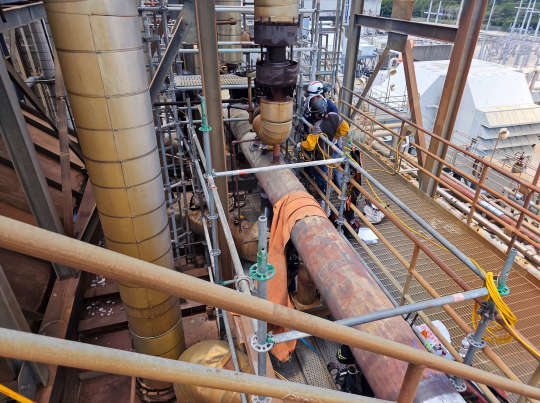
By Day 7, the inspection results were worse than expected. More scope emerged, and repairs became critical-path work. The scaffold contractor was notified, but couldn’t mobilize for three days. Inspection crews stood by for four days waiting for access. A pipefitting contractor was brought in.
The schedule was at risk. Costs were climbing. Family time was being lost.
By Day 13, new access was complete. Inspections confirmed the damage was contained, and the repair plan was issued. Fitters finally got to work on Day 14, after the inspection contractor cleared the area. Repairs were completed by Day 16. Welds were inspected, and de-blinding was underway—just as the puck dropped at your daughter’s game.
It didn’t have to be this way.
The handoff tax
Multi-vendor models rarely fail because people are incompetent. They fail because handoffs compound.
Every contractor interface can add friction: scope interpretation, scheduling, permitting, access, readiness, QA/QC, and rework. In the field, that friction becomes a hidden tax: the handoff tax.
The one-owner integrated model can work well when tasks are path-dependent—when the next step relies on the previous one being completed. Asset integrity work is full of this uncertainty: “We opened it up and it’s worse than expected.”
In those situations, the plan is a hypothesis. When reality meets the plan, delays can compound, schedules can drift, and costs can rise. An integrated team can move from one step to the next with fewer handoffs and less risk of waiting between contractors.
Example: Coating repair on a 500 m gas line crossing a river
The project involved a remote, environmentally sensitive location with restricted access and major repairs anticipated after inspection.
The integrated solution brought together one team for:
- Structural and access engineering
- Rope access
- Inspection
- Mechanical trades
The approach included:
- One point of contact for the full scope
- A smaller crew
- Optimized access and containment using V-Deck and shrink-wrap hoarding
- Laser ablation instead of blasting
- On-site engineering to direct carbon-fibre wrap repairs when unplanned scope emerged
- One crew for installation, repairs, and recoating
- No repeat mobilizations to the remote site
Why coordination affects total cost
In multi-vendor setups, each step may be optimized locally while the overall system is sub-optimized. Scaffolders may not bear the cost when inspectors and trades wait for modifications. Inspectors may not bear the cost when discovered work waits for repair crews.
Everyone invoices. The asset owner pays—often through standby time and lost production, not just unit rates.
There are cases where multiple vendors make sense, particularly for large-scale or highly specialized work. But the trade-off can be a significant coordination burden.
A rule of thumb
- High uncertainty + high dependency = integrate
- Repeatable + low dependency = keep modular and competitive
The strategic question for leadership isn’t “Who’s cheapest per unit?” It’s: What is the cost of coordination—in extended downtime, contract management, scope creep, or eroded reliability?
Choosing the Right Model for the Work
There’s no single delivery model that fits every project. The key is to match the approach to the work: when scope is uncertain and tasks depend on one another, reducing handoffs can help keep the work moving; when tasks are repeatable and independent, a multi-vendor approach may be the right choice.
For asset integrity projects, the decision should account for the full cost of coordination—not just the unit rate. If you’re evaluating the right approach for your next project, contact Acuren to discuss your requirements.