Written by Tom Taylor, Director of Canada Rope Access Industrial Services at Acuren, this series explores the business side of asset integrity and maintenance. Drawing from more than a decade of experience supporting major industrial operators across Canada, the series focuses on the operational decisions, technologies, and execution models that influence cost, uptime, risk, and long-term asset performance.

In turnarounds and integrity programs, even the best plan can change quickly.
You can have the scope sequenced, permits lined up, resources loaded, and the schedule mapped out in detail. Then the work starts. Access changes. Weather moves in. Inspection finds something worse than expected. Suddenly, what began as an inspection scope becomes a mitigation challenge.
That is when the real test begins.
Because what decides whether a turnaround stays on track is not always the Gantt chart. It is the field culture behind the work.
As Mike Tyson famously said, “Everyone has a plan until they get punched in the face.” In turnaround execution, you want the team that can take the punch, adjust quickly, and keep moving.
When the Plan Meets Reality
Turnarounds are built around planning, but they are executed in real-world conditions. Crews are often working in tight windows, under changing site conditions, with multiple scopes moving at once. Even with strong preparation, unexpected issues are part of the work.
The difference is how teams respond.
When inspection identifies a problem that needs mitigation, the best crews do not stop at the limits of the original scope. They do not default to “that’s not my job.” They ask the more useful question:
“What does it take to get this done safely and stay on plan?”
That mindset matters. Every handoff creates delay. Every delay creates pressure. And when delays compound, a manageable issue can quickly become a major schedule problem.
Culture as the Contingency Plan
At Acuren, we have benefited from crews who take pride in solving difficult field challenges. These are people who understand that execution is not just about following a plan. It is about reading the situation, reacting with discipline, and finding a safe path forward when conditions change.
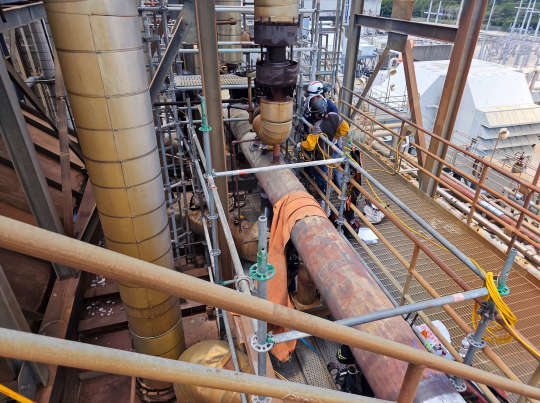
A strong example came during a client turnaround when our regional manager, Grant Lamb, received a call from a client in crisis. Inspection had identified a problem that required difficult access to mitigate. It was not part of his original scope, but it was now the client’s problem, so he treated it like his own.
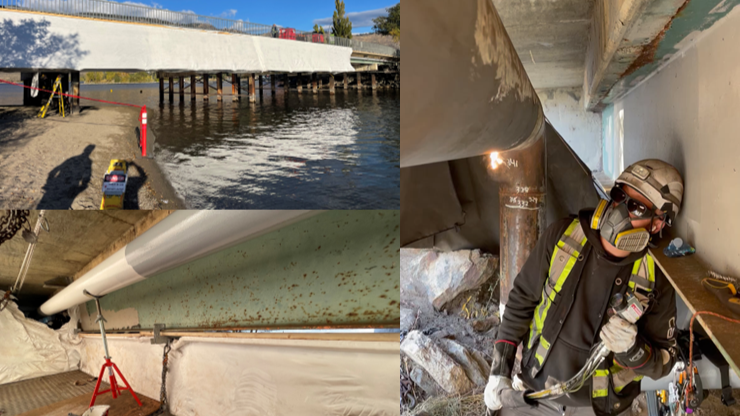
Grant called Mitch Ford and Stevie Bage, our alternative access program managers. They quickly built a plan, mobilized the right equipment, and within hours had a trailer loaded with V-Deck in Edmonton and en route to site.
You cannot spreadsheet that response.
That is culture becoming the contingency plan.
The Behaviours That Keep Work Moving
In integrated execution, technical capability matters. So do rates, equipment, resources, and planning. But when the scope changes mid-turnaround, culture is what determines whether a team protects the schedule or adds friction to it.
There are three behaviours that stand out:
Low Ego
The best field teams collaborate hard. They listen, challenge assumptions, and let the best idea win, regardless of where it comes from. When conditions change, ego slows the response. Collaboration speeds it up.
Problems Become Opportunities
Strong crews do not bring excuses. They bring options. When a problem appears, they focus on what can be done safely, practically, and quickly to support the client’s objective.
Do What Is Needed
Sometimes the right answer is not glamorous. It might mean helping outside the original scope. It might mean taking on difficult work because the project needs it. It might even mean shoveling coal for 10 hours if that is what keeps the work moving.
That willingness matters because every “not my job” becomes a handoff. Every handoff becomes a delay. And in a turnaround, delays rarely stay isolated.
Choosing the Right Integrated Partner
When operators choose an integrated partner, they often focus on capability, rates, schedule, and available resources. Those are important. But culture deserves the same level of scrutiny.
Ask what happens when the plan meets reality on Day 3.
Does the team protect the schedule or protect its scope boundary? Do they bring solutions or reasons why something cannot be done? Do they collaborate across disciplines, or do they create another handoff?
In high-pressure turnaround environments, the answer to those questions can have a direct impact on cost, schedule, safety, and asset performance.
Conclusion
A strong strategy is essential, but strategy alone does not carry a turnaround through unexpected conditions. Field culture does.
The best teams know how to adapt without losing discipline. They understand the urgency of the work, the importance of safety, and the value of solving the client’s problem as if it were their own.
That is what keeps a turnaround moving when the schedule gets tested. That is what separates an integrated partner from a service provider. And that is why, in turnarounds and integrity programs, culture does not just eat strategy for breakfast. It eats schedules for lunch.
If your team is planning an upcoming turnaround or looking for an integrated partner that can support inspection, access, and mitigation work when conditions change, contact our team to start the conversation.
A special note on Grant Lamb: Grant is a legend in the field, known for being obsessive about his people, quality, and safety. That is why when he called, Mitch Ford and Stevie Bage simply said, “Anything for you, buddy,” and got to work.