Project Impact
- Lowered reliability risk on a critical operating asset
- Gave the plant reliability team a clearer understanding of how floor movement was affecting the roaster
- Identified a low-frequency response at 1.8 Hz that helped focus the investigation on the support structure, not just the roaster itself
- Provided the technical basis for structural review, FEA, and targeted mass and stiffness modifications
- Helped the client move from repeated structural issues to a more defined corrective path
Understanding the Source of Structural Movement
Industrial assets do not operate in isolation. The behavior of the surrounding structure can influence how equipment performs, especially when large, heavy, or dynamically loaded assets are involved.
In this case, the client was managing recurring structural issues on a large smelter roaster. Roof and support failures had been observed during operation, creating concern around the long-term reliability of the asset. The reliability team needed to understand whether the issue was related to the roaster itself, the floor beneath it, or the way the two were interacting.
Acuren’s role was to assess the vibration behavior of the support structure, with particular attention to smelter roaster vibration, roaster resonance, and movement of the supporting floor. This was important because vibration-induced structural failure can be difficult to diagnose without field data that shows how the structure is actually responding during operation.
Large Mass Impact Testing and Industrial Vibration Analysis
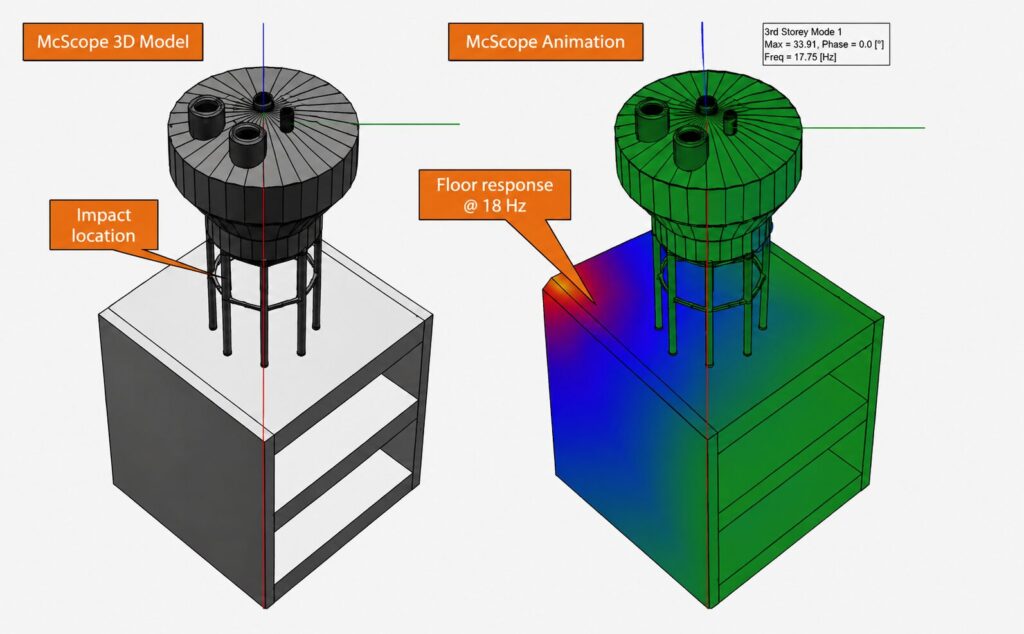
Acuren completed large mass impact testing to measure the structure’s response under controlled input. The structure was impacted with a 500 lb. mass, with input measured by a force sensor and response measured using low-frequency accelerometers. Testing included one impact location on floor 5 and more than 60 response locations across five floors.
The collected data was used to complete transfer function analysis and create a 3D model of the roaster and supporting structure. This allowed Acuren to visualize the dynamic structural response and better understand how vibration was moving through the structure.
The analysis identified a low-frequency transfer function at 1.8 Hz. The model showed that the roaster was responding to movement of the floor, helping shift the investigation toward the supporting structure rather than treating the roaster as the only source of concern.
A Clearer Path for Reliability Engineering
With the source of the response better understood, Acuren provided a path forward for further structural review. The recommended next steps included finite element analysis and the identification of structural modifications, including potential mass and stiffness modifications.
This gave the client a stronger basis for decision-making. Instead of continuing to respond to structural failures as isolated events, the reliability team had measured data showing how the floor and roaster were interacting. That insight helped support more focused corrective action and strengthened the client’s broader reliability engineering approach.
The Outcome
The assessment helped reduce floor response and lower reliability risk for the smelter roaster and its supporting structure.
For industrial operators managing critical assets, this project shows the value of combining field testing, industrial asset reliability knowledge, and engineering analysis. When structural movement is affecting operation, the issue may not be obvious from visual inspection alone. A structured vibration assessment can help determine whether equipment, supports, foundations, or surrounding structures are contributing to the problem.
By using large mass impact testing, transfer function analysis, and 3D modeling, Acuren helped the client better understand the root of the response and move toward practical structural modification.
Conclusion
This project demonstrates how Acuren supports industrial reliability teams with advanced vibration assessment and practical engineering insight. By identifying how the roaster and supporting structure were interacting, Acuren helped the client reduce uncertainty, focus corrective action, and lower reliability risk.
If you are managing recurring structural vibration, resonance, or reliability concerns, contact us to learn how Acuren can support your team.